Before the Shoot: How AI Is Transforming the Most Important Stage Nobody Talks About

Every major TVC you have ever seen was tested before it was made. With real consumers, in a controlled research setting, before a single rupee of production budget was committed. The tool used for that testing has a name most people outside the industry have never heard: the animatic.
An animatic is a rough, sequenced version of a planned advertisement - scripted, voiced, timed, and set to music - built to approximate what the final film will look and feel like. It is not a storyboard. It is not an internal mood board. It is a research instrument, shown to closed consumer groups to answer a specific question: is the message landing?
For any TVC with serious media spend behind it, animatic copy testing is the industry's primary mechanism for de-risking an expensive decision. Brands typically test two to three script variants per research cycle, sometimes more. This is how the industry makes sure it is not about to waste crores on a film that does not work.
The Constraint Nobody Solved
For all its importance, animatic production has always been slow and expensive relative to what it delivers. Traditional animatic formats run timelines of 10-12 days at best, but mostly longer. Multiply that by two or three script variants and you are looking at a pre-production research cycle that can stretch to a month before a shoot is even confirmed.
That timeline has a direct consequence on research quality. The number of variants a brand can afford to test is constrained by the cost and time of producing each one. Test two scripts instead of five, and you may be committing to a creative direction without ever knowing whether a better version existed.
Nobody could solve this problem for decades. Animatic production got incrementally faster as digital tools improved, but the fundamental economics did not change. You still needed skilled animators, an editor, voiceover sessions, and multiple client review cycles before you had something fit for a research room.
AI has changed that.
What AI Actually Changes
The discussion around AI video in advertising has largely focused on one end of the production pipeline. Everyone is asking whether AI can replace the final film. The more immediate and commercially significant disruption is happening earlier - at the animatic stage - for reasons that are both practical and structural.
Practically: AI video tools can now produce directed, sequenced, voiced visual content that communicates pacing, tone, product narrative, and scene composition in days, not weeks. The time cost of producing a single animatic variant has collapsed.
Structurally: that collapse changes the economics of copy testing entirely. If producing an animatic variant takes days rather than a fortnight, brands can now afford to test four or five script versions instead of two or three. More variants tested means richer consumer insight. Richer insight means a better creative decision before the production budget is committed. The research itself gets better - not just faster.
There is a fidelity dimension too. AI-generated animatics can be significantly closer to photorealistic than traditional animation, and better represent what the final ad will look like. Focus group research becomes cleaner. Consumer responses reflect the idea more accurately, and the noise introduced by rough production quality decreases.
This matters because the one legitimate criticism of animatic testing has always been fidelity risk - the possibility that consumers react to the roughness of the stimulus rather than the idea itself. AI substantially reduces that risk without increasing production time or cost.
From TVCs to Performance Advertising
The implications extend beyond television.
The animatic methodology - build a rough version, test consumer response, iterate before committing budget - is directly transferable to digital performance advertising. Test headline variants. Test different opening scenes. Test CTA copy. Test emotional register. All before a media rupee is spent.
This is A/B testing, but upstream. The difference between testing creatives for adfilms at the animatic stage versus testing them in-market is the difference between learning before you spend and learning after. In-market A/B testing tells you what worked after you have already paid for the media. Animatic-stage testing tells you before.
For performance marketers who run high volumes of creative across multiple platforms, the ability to rapidly produce and test animatic variants of digital ads - at AI speed and cost - represents a genuinely new capability. The brands that build this into their creative process will not just make better ads. They will accumulate consumer insight at a rate their competitors cannot match.
Case Study: Everyuth Naturals
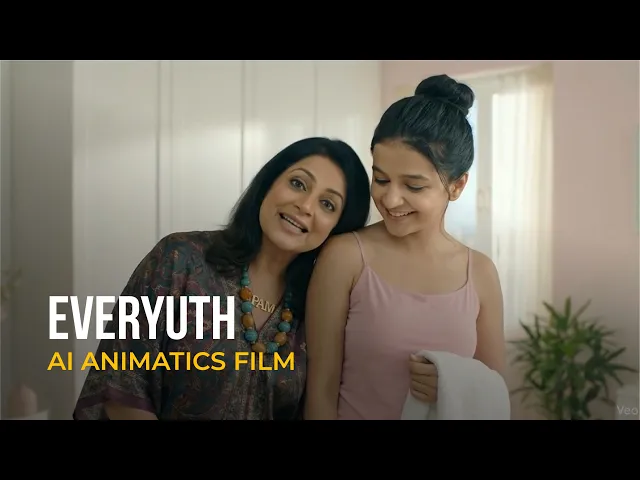
When Zydus came to us with a brief for a DVC for their Everyuth Naturals tan removal face wash, a shoot was planned and the brief was clear. Before committing to production, they needed an animatic - a research-grade version of the planned film to test with consumer groups and validate the creative direction.
We built it using our AI video production system. The full animatic was delivered within days.
The result was a directed, sequenced piece that functioned as valid copy testing stimulus - communicating the visual language of the planned DVC, the tonal register of the brand, and the product message clearly enough for real consumer research to be conducted against it. The process from brief to research-ready material was faster than any traditional animatic workflow would have allowed.
The Bigger Shift
Pre-production has long been treated as the part of advertising you endure before the real work begins. The brief, the boards, the animatic, the research - necessary friction between an idea and a film.
What AI is doing at the animatic stage is not eliminating that friction. It is making it productive. The research stage, long constrained by the cost of producing test material, can now be as thorough as the idea deserves. Brands can test more, learn more, and commit to production with a level of consumer validation that was previously available only to those with the largest budgets and the longest timelines.
The tool that was always essential but always rushed is, finally, getting the time and resource it deserved.